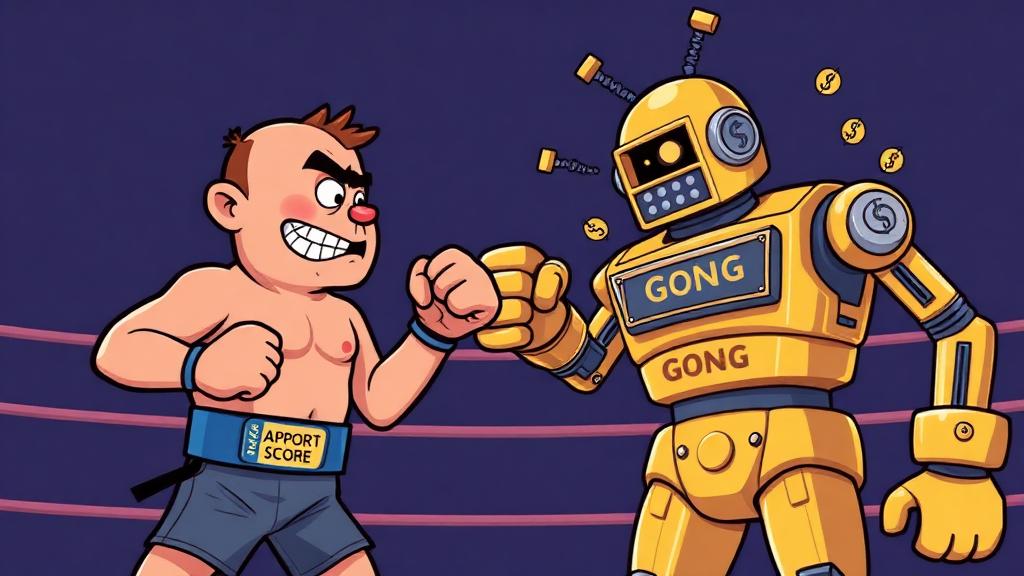
Rapport Score vs. Gong: David's Belt vs. Goliath's Invoice
Gong charges roughly $1,600 per user per year — plus a $50,000 platform fee — to tell you that you talked too much on a call. Groundbreaking. Meanwhile, Rapport Score actually teaches you how to communicate like a human being, complete with a belt progression system that makes getting better at sales feel like earning your black belt in karate. One tool drains your budget; the other upgrades your brain. We break down why behavioral coaching beats expensive call recording, why belts beat badges, and why your CFO will finally stop crying at budget meetings.

RapportScore.ai Team
Product & Growth
The Elephant in the Sales Floor: Gong's Price Tag
Let's start with the number that makes every CFO reach for the antacids: Gong's pricing. At approximately $1,600 per user per year — on top of a platform fee that can reach $50,000 — Gong is one of the most expensive tools in your sales stack. And what do you get for that investment? Call recordings, talk-to-listen ratios, and the revolutionary insight that your reps are talking too much.
We're not saying call recording is worthless. We're saying it's table stakes in 2026 — and charging a premium for analytics that tell you what happened without changing how your team communicates is like paying a fortune for a rearview mirror when what you need is driving lessons.
RapportScore costs a fraction of Gong's price because we focused on the thing that actually moves the needle: developing the behavioral skills that make your team better communicators, not just better-recorded ones.
Recording vs. Development: The Fundamental Difference
Gong records calls and extracts data. That data is valuable for deal intelligence — knowing what was discussed, what competitors were mentioned, what objections came up. For pipeline management and forecasting, Gong delivers.
But here's the gap: Gong tells you your rep talked for 72% of the call. It doesn't teach your rep how to listen. It flags that a deal might be at risk because certain keywords weren't mentioned. It doesn't develop the conversational instincts that would have surfaced those keywords naturally.
RapportScore starts where Gong stops. We analyze the behavioral patterns underneath the conversation — presence, acknowledgment, regulation, adaptability — and provide specific, actionable coaching that changes how your team shows up in their next call.
The analogy is simple: Gong is game film. RapportScore is practice.
Why Belts Beat Badges (and Leaderboards)
Gong has leaderboards. Your reps can see who has the best talk-to-listen ratio, who asks the most questions, who mentions the product most. Gamification through competition.
The problem with leaderboards is that they optimize for metrics, not skills. Reps game the numbers — asking unnecessary questions to improve their "questions asked" score, awkwardly pausing to adjust their talk ratio. The metrics improve while actual communication quality stays flat.
RapportScore's belt system measures behavioral consistency, not individual metrics. You don't earn a belt by gaming a number — you earn it by demonstrating sustained improvement across multiple behavioral dimensions in real conversations. And belts can regress, ensuring your rating always reflects your current capability.
Belts are aspirational in a way leaderboards aren't. Nobody brags about their talk-to-listen ratio at dinner. People will absolutely tell you they earned their Blue Belt in conversational intelligence.
The Skill Transfer Problem
Ask any sales leader: "Can your top rep explain why they're good?" Most can't. They have instincts they've never made conscious. They read rooms by feel. They close through some invisible connection that can't be taught — or so everyone assumes.
Gong doesn't solve this. Watching the recording of a great call doesn't transfer the skill any more than watching a tennis match makes you a tennis player. The data shows what happened. It doesn't show the internal process that made it happen.
RapportScore's progression system makes the unconscious conscious. Each belt level codifies a specific layer of conversational mastery — from presence (White) to room-reading (Yellow) to conversation design (Brown) to teaching others (Black). Your top rep's instincts become a learnable framework.
That's how you scale excellence. Not by recording excellence — by developing it.
The Bottom Line
If you need deal intelligence, pipeline visibility, and competitive tracking — Gong delivers. If you need your team to actually get better at having conversations — that's RapportScore.
And at a fraction of the cost, the ROI math isn't even close. Your CFO will send us a thank-you card.
The best sales teams in 2026 will use both — Gong for the data, RapportScore for the development. But if you have to choose, ask yourself: do you need to know what happened on the last call, or do you need the next call to go better?
Frequently Asked Questions
How much does RapportScore cost compared to Gong?
RapportScore costs a fraction of Gong's pricing, which runs approximately $1,600 per user per year plus a platform fee up to $50,000. RapportScore focuses investment on behavioral development rather than call recording infrastructure.
Is RapportScore a Gong replacement?
RapportScore and Gong serve different purposes. Gong excels at call recording and deal intelligence. RapportScore develops conversational skills through behavioral measurement and coaching. The best teams may use both.
What does RapportScore do that Gong doesn't?
RapportScore measures behavioral patterns (presence, acknowledgment, regulation), provides a 6-belt progression system for skill development, offers AI roleplay for practice, and delivers specific coaching that changes how your team communicates — not just what they talk about.
Can I use RapportScore and Gong together?
Yes. Many teams use Gong for deal intelligence and pipeline management while using RapportScore for behavioral coaching and skill development. The two platforms complement each other.